A client asks for a finishes package and means something quite specific, but the phrase covers several documents that do different jobs. Getting them confused is how a project ends up with a beautiful presentation nobody can order from.
The short definition: a finishes package specifies every hard finish in the project — what it is, where it goes, who makes it, and how much is needed — precisely enough that someone who has never spoken to you can price it and buy it.
The short answer
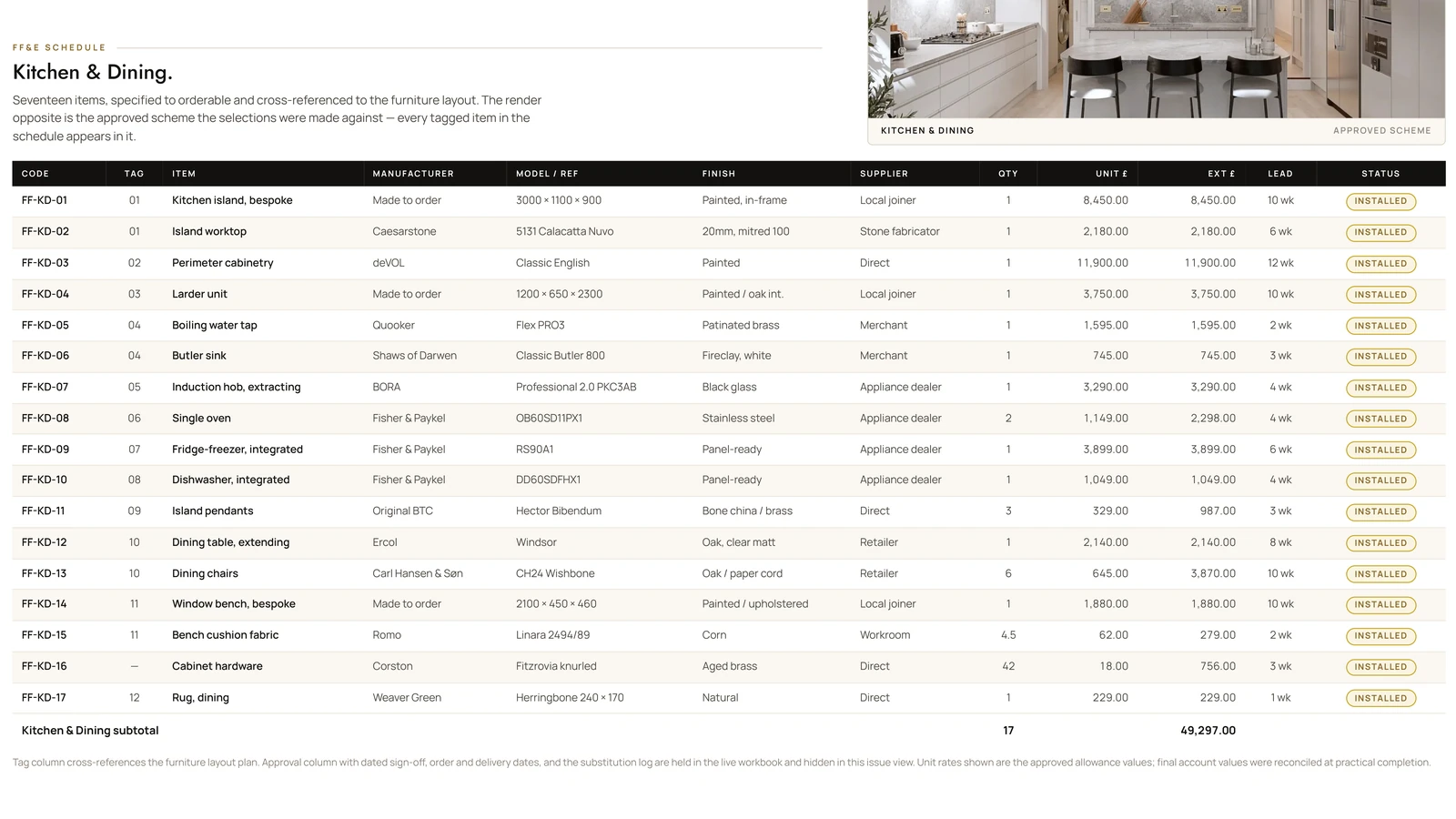
A finishes package specifies every hard finish in the project — what it is, where it goes, who makes it and how much is needed — precisely enough that someone who has never spoken to you can price it and buy it. It is written for four readers at once: the builder needs quantities and locations, the trade needs setting-out and tolerances, the supplier needs the manufacturer’s exact product and finish codes, and the client needs to understand what they are approving and what it costs. Vagueness anywhere becomes a provisional sum, and provisional sums become arguments. It covers the same hard finishes the construction half of an FF&E schedule carries.
The four readers
Every decision about a finishes package follows from who is holding it.
The builder needs quantities and locations to price the job. Vagueness here becomes a provisional sum, and provisional sums become arguments.
The trade needs the installation detail — the setting-out, the grout colour, the direction of the grain, the tolerance. They are reading on site, often on paper, often in poor light.
The supplier needs the product code and the finish reference exactly as the manufacturer writes it. Not "warm brass" — the actual code.
The client needs to understand what they are approving and what it costs. They are the only reader who cares what it looks like.
One document cannot serve all four well. That is why a package is a set.
What the package contains
The finishes schedule. The backbone. Every finish, by room and by surface, with manufacturer, product name, code, size, finish, and quantity with a wastage allowance. This is the document that gets ordered from.
Specification sheets. One per significant item — the tile, the tap, the stone, the paint. Image, full technical detail, supplier contact, lead time. These are what get forwarded when someone asks "what exactly is this?"
Finish legends and location plans. The link between the schedule and reality. A plan with tags showing which finish goes where, so nobody has to infer it from a room name.
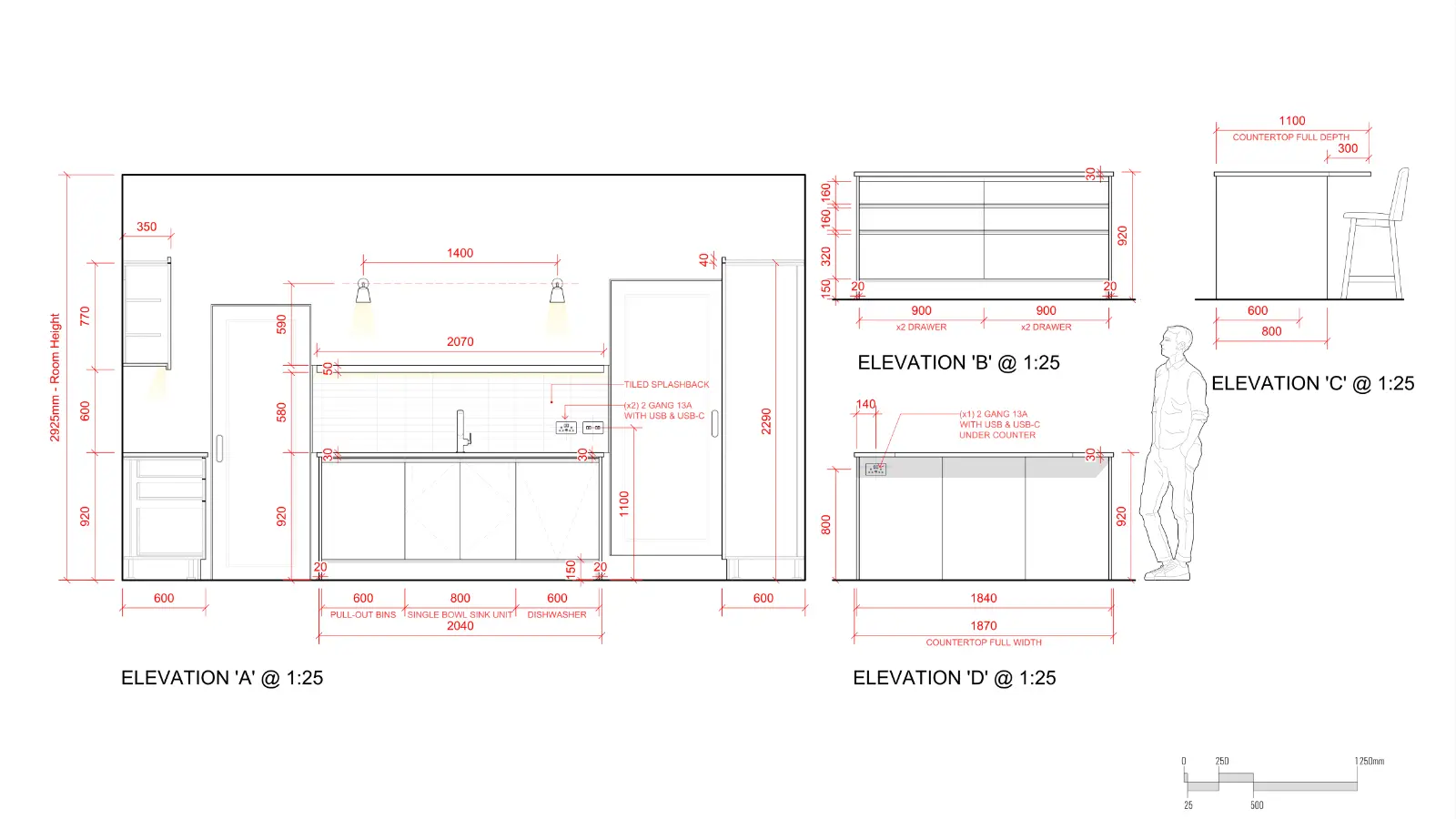
Setting-out and detail drawings where a finish needs them — tile layouts starting from a datum, feature walls, anywhere the pattern has to be deliberate rather than accidental.
A sample register. What was sent, when, and what was approved. Boring, and the single most useful document when a dispute starts.
Why a moodboard is not a specification
A moodboard says: this is the feeling. A specification says: this is the item, and here is its code.
Both are necessary and they are not interchangeable. The failure mode is a package that looks like a presentation — full of atmosphere, light on codes — handed to a builder who now has to guess. Every guess is either a delay while they ask, or a substitution you did not approve.
The test is blunt: could someone order the entire project from this document without contacting you? If not, it is a presentation.
One row, written properly
Everything above is abstract until you see the difference between a line that can be ordered and a line that cannot. Both of these describe the same floor.
Not orderable: “Warm oak flooring, wide plank, matt finish, throughout ground floor.”
Orderable:
| Field | Value |
|---|---|
| Code | FL-01 |
| Location | Ground floor — hall, living, dining. Not kitchen (see FL-02). |
| Product | Manufacturer name, range, exact product reference as written by them |
| Size & format | 220 × 2200 mm plank, 14 mm engineered, 4 mm wear layer |
| Finish | Manufacturer’s matt hardwax oil, factory applied |
| Setting out | Planks run parallel to the hall axis; start full plank at the door threshold |
| Quantity | 48 m² net plus 10% cutting allowance = 53 m² |
| Notes | Confirm dye lot; all areas from one batch. Underfloor heating compatible. |
The second version can be priced by a builder, ordered by a supplier and laid by a trade without any of them phoning you. That is the entire test, and every field above exists because leaving it out has cost somebody a re-order.
Where packages usually fail
Discontinued products. Specify something that has gone out of production and the substitution decision moves to the builder, who will optimise for price. Check availability and lead time before it goes in the schedule, not after.
No wastage allowance. Ordering exact quantities guarantees a shortfall, and the second order is from a different batch. Tile and stone shade-vary between batches; a 10% allowance is not padding, it is insurance.
The schedule and the drawings disagree. The most common and most expensive failure. When a finish changes late, it has to change in every document that mentions it. One source of truth, cross-checked before issue.
Nobody named the approver. If it is not written down who signed off which finish, everyone remembers it differently.
When to commission one
After the design is settled and before anyone prices the job. Too early and you are specifying decisions that will change. Too late and the builder has already priced from assumptions, which means every correction is a variation.
The window is narrower than people expect, and it is the moment where documentation earns its fee — not because the drawings are beautiful, but because they remove the ambiguity that turns into cost.