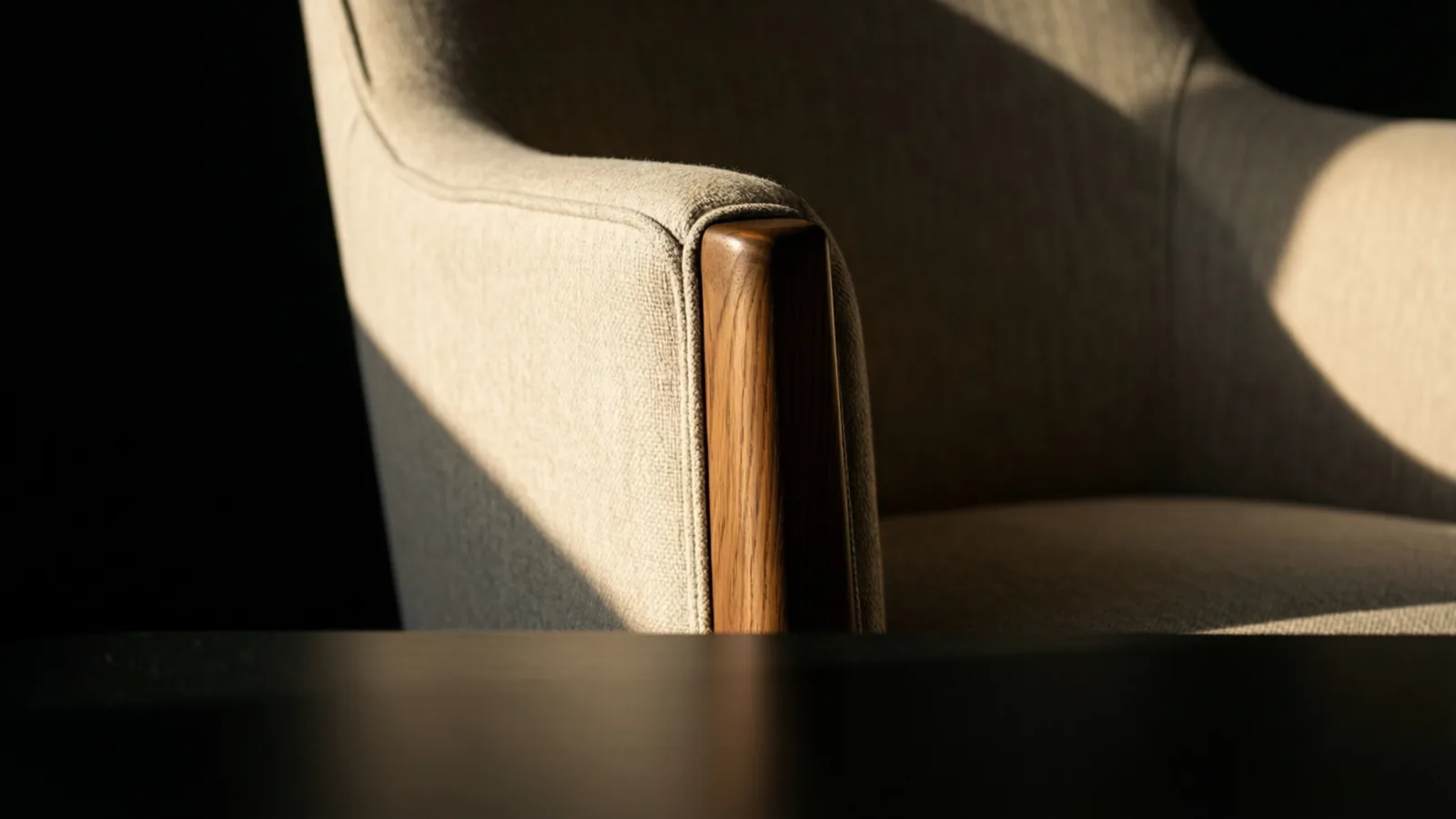
Furniture is the category where CGI economics are most obviously favourable, and the reason is not image quality. It is that one model produces an entire range.
The short answer
The commercial case is not image quality — it is that one model produces the entire range. A sofa exists once as a 3D model, and from it come every fabric, leg finish, configuration and camera angle without a warehouse, a studio or a delivery van. Photographing twelve fabrics needs twelve sofas or one sofa reupholstered twelve times; rendering them needs one model and twelve material assignments. The first image carries the cost of building the model; every variant after it is a fraction of that, which is why the economics improve with every SKU.
One model, every variant
A sofa exists once as a 3D model. From that single model you produce every fabric, every leg finish, every configuration and every camera angle — without touching a warehouse, a studio or a delivery van.
That is the whole commercial case. A photoshoot of a sofa in twelve fabrics requires twelve sofas, or one sofa reupholstered twelve times, plus the logistics of getting them into a studio. Rendering it requires one model and twelve material assignments.
| Image type | Typical cost | Notes |
|---|---|---|
| Product on plain background | Low hundreds | E-commerce standard. Cheapest per SKU. |
| Additional finish or fabric | A fraction of the first | Model and lighting reused |
| Additional camera angle | Low | Same scene, new view |
| Lifestyle in a built room | Higher | The room must be built first |
| Detail and material close-ups | Low to moderate | Often the strongest converters |
| The first image of a new product | Highest | Modelling and material setup lives here |
Note the shape of that table. Almost all the cost is in the first image. Brands that treat CGI as a per-image purchase find it expensive. Brands that treat it as building an asset library find it cheap, because everything after the build is nearly free.
Rendering before you manufacture
This is the part that changes how a range launches, and it is under-used.
Images can be produced from technical drawings before tooling is committed. That means you can put a range in front of buyers, run it past a focus group, or open pre-orders — all before spending on production.
It also means catalogue and e-commerce imagery is ready on launch day rather than six weeks after, which is normally the gap between stock arriving and photography being scheduled, shot and retouched.
The caveat: the render is only as accurate as the drawing. If the manufactured piece differs from the specification, the images are wrong and you have a returns problem. Render from the final drawings, not the concept ones.
Where furniture CGI actually fails
Three materials cause most of the problems, and they are worth knowing before you commission.
Leather. Uniform grain across a whole sofa is the giveaway. Real leather pulls at the seat, softens at the arm and stays taut across the back. Wear is not damage — it is the evidence that makes it read as leather.
Velvet and pile fabrics. Pile has direction, and direction changes the apparent colour. The same velvet reads two tones depending on which way it was last brushed. A flat velvet in a render is just matte fabric.
Timber. "Oak" is not a specification. There are a hundred oaks and they photograph differently. Grain direction has to follow the actual fabrication, not the convenience of the texture map.
If your renders look plausible but slightly wrong, one of these three is usually why.
What to send
- Technical drawings or a CAD model with real dimensions. Not a sketch, not a photograph with a tape measure.
- Material specifications — fabric composition and weave, finish codes, sheen levels. Naming the supplier product is better than describing it.
- Physical samples where possible. Nothing replaces having the material on the desk.
- Reference photography if a prototype exists, even phone photographs in daylight.
- The intended use — e-commerce grid, catalogue spread, trade presentation. These are different images and knowing which changes the framing.
The asset list, precisely
What a studio needs from a furniture brand is more specific than “drawings and photos”, and sending it in one go is the difference between a week and a fortnight.
- Dimensioned drawings or CAD. Overall sizes plus seat height, seat depth, arm height and back angle. Those four are what make a sofa look like your sofa rather than a generic one.
- Construction detail where it shows. How the cushion meets the frame, whether the seam is piped or plain, how the leg joins. This is the level at which CGI stops looking like CGI.
- Fabric scans, flat and square. Photographed straight on in even light, with a ruler in frame so scale is recoverable. A photograph of a cushion is not a fabric scan.
- Physical samples for anything difficult — bouclé, velvet, anything with sheen or depth. A scan cannot record how a pile catches light.
- The colourway list, with references. Names and codes, in the order you want them delivered.
- One reference photograph of a real unit, however imperfect. It settles a dozen questions no drawing answers.
Brands that send that set get a first image that is nearly right. Brands that send a PDF brochure get a first image that is a conversation.
A note on configurators
Once a product exists as a model with separated materials, a web configurator is a smaller step than most brands assume — letting customers choose fabric and finish and see the result.
It is not free, and it is not the first thing to build. But it is worth knowing that the modelling work you pay for on image one is the same asset a configurator needs, so the two decisions are related.
Where to start
Pick your three best-selling products rather than your whole range. Build those properly, use them across e-commerce, catalogue and trade, and judge the return before committing the rest.
For the listings side specifically, see 3D rendering for e-commerce product listings. To get a quote, send the drawings and specification.