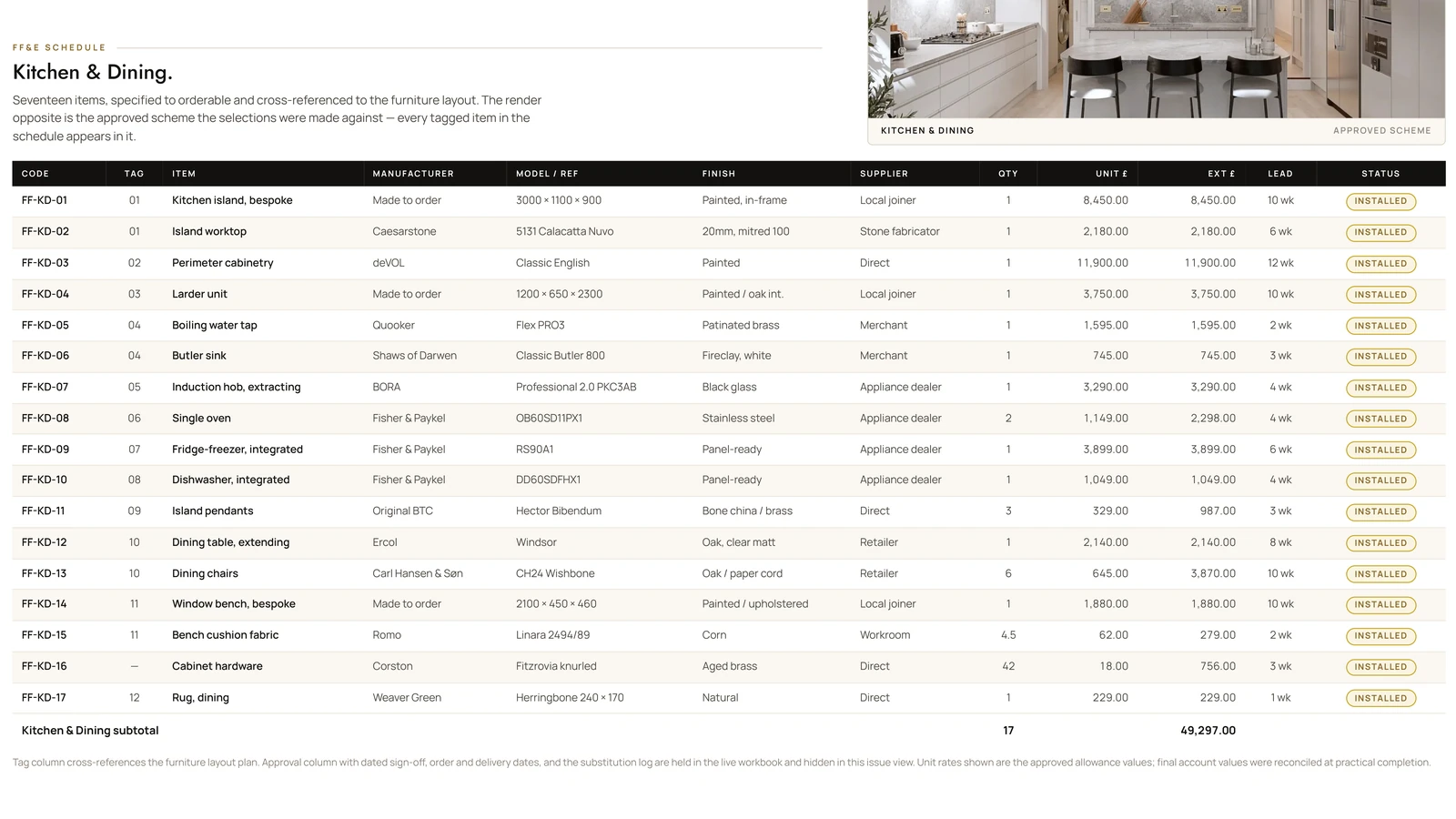
These two documents get used interchangeably, and the confusion is understandable — FF&E stands for furniture, fixtures and equipment, so a furniture schedule sounds like a subset of it.
In practice they belong to different phases of a project, go to different people, and fail in different ways. Treating them as one document is why some projects arrive at handover with a beautiful schedule that the builder never priced from.
The short answer
The difference is when, not what. An FF&E schedule is a construction document covering everything specified before or during the build — tiles, stone, paint, tapware, sanitaryware, lighting, joinery finishes, ironmongery — and the builder prices from it, so it has to exist before anyone quotes. A furniture schedule is a procurement document covering the loose items bought in the decorating phase: sofas, chairs, tables, rugs, lamps, art. Nobody builds from it; someone orders, tracks and receives from it. Crudely: if it would still be there when you tipped the building upside down, it belongs in the FF&E schedule.
Where the line sits
The cleanest distinction is not what but when.
The FF&E schedule is a construction document. It covers everything specified before or during the build — tiles, stone, paint, tapware, sanitaryware, lighting, joinery finishes, ironmongery. The builder prices from it. It has to exist before anyone quotes.
The furniture schedule is a procurement document. It covers the loose items bought during the decorating phase — sofas, chairs, tables, rugs, lamps, art, accessories. Nobody builds from it; someone orders from it, tracks it, and receives it.
Put crudely: if it would still be there when you tipped the building upside down, it belongs in the FF&E schedule.
Why they cannot be one document
They carry different columns because their readers need different things.
An FF&E schedule needs location, area or quantity with wastage, product code, finish reference, and a link to the drawing that shows where it goes. A builder reads it against a plan.
A furniture schedule needs supplier, lead time, order status, delivery date, cost, and often a client-facing image. A procurement coordinator reads it against a calendar.
Try to serve both in one spreadsheet and you get a document that is too heavy for the builder and too technical for the client — the classic failure where everyone receives it and nobody uses it.
The overlap, and how to handle it
There is a genuine grey zone: decorative lighting, built-in seating, feature joinery, sometimes window treatments. Items that are specified early but procured late.
The rule that resolves it: put the item where the money decision happens. If the builder has to allow for it in the contract sum, it goes in the FF&E schedule, even if you order it yourself later. If the client buys it separately after practical completion, it goes in the furniture schedule.
Then cross-reference. An item that appears in both should say so in both, with the same reference. The cost of a duplicate is small; the cost of an item that appears in neither is a phone call from site.
Which document does this item belong in?
The boundary cases are what cause the arguments, so here they are settled. The test: does a trade install it as part of the build, or does somebody deliver it after the builder has left?
| Item | Goes in | Because |
|---|---|---|
| Wall lights, downlights, switches | FF&E schedule | Wired in. The electrician prices and installs them. |
| Table and floor lamps | Furniture schedule | Plugged in and delivered late. |
| Fitted wardrobes, island joinery | FF&E schedule | Built or installed on site. |
| Freestanding sideboard | Furniture schedule | Arrives on a van. |
| Tapware, sanitaryware, appliances | FF&E schedule | Services connect to them; they must be priced before the walls close. |
| Rugs, cushions, art, accessories | Furniture schedule | Nobody builds around them. |
| Curtains and blinds | Both, split | The track or recess is construction; the fabric is procurement. |
That last row is the one worth internalising. Half the failures in this area are a beautiful curtain specification with no recess detailed, discovered when the ceiling is already up.
Which you actually need
Full renovation or fit-out: both. The FF&E schedule first, because it gates the pricing. The furniture schedule once the shell is settled.
Decorating-only project: usually just the furniture schedule, with a short finishes list if you are touching paint or floor coverings.
New build with a separate architect: the FF&E schedule is often partly theirs already. Find out what exists before duplicating it — overlapping schedules from two consultants is worse than one incomplete one.
The practical answer
Build them as two documents with a shared structure, so moving an item between them is a copy rather than a rewrite. Same column logic, same naming, same reference format.
Most of the pain in this area comes not from choosing wrongly but from choosing late — deciding at the point where the builder asks for pricing information, rather than at the point where the design settled. Decide early, and the question mostly answers itself.